

When nobody can tell you apart, the choice gets made on price
Open your phone and search for the service you provide in your town.
Look at the first twelve businesses, and read what each one says about itself. Trusted. Experienced. Local. Honest. Quality service. Fair prices. We care. We do it right...
Now cover the names and read them again. Could you tell which words belong to which business? Neither can the customer who search. They come looking for a reason to choose one business, and every business gives them a different version of the same answer.
So they choose on whatever's left. Who answers first. Who's closest. Who takes their insurance. Who charges less. None of that's about whether you're any good at this, and none of it's in your hands.
Then you end up defending work you know is better to somebody who was never shown why it was better. Most of those twelve businesses do good work, and so do you. But a customer can't choose what they can't see. And we're not talking about a clever slogan. This is about showcasing the excitement your customers feel about how you do business.
The half you can't write about yourself
What do your best employees proud of? You may have stopped noticing it years ago because it's just how you do business. But to your most loyal clients, it's what makes them happy to continue coming back to you.
Most marketing companies never ask.
A website project usually begins with a blank page. Somebody asks what your business does, how long it's been open, what services you provide, and what you want your customers to know.
You give honest answers: quality work, good people, fair prices, years of experience, and care for the customer. The writer turns those answers into sentences. But then the results sound like every competitor, because nobody uncovered and showcased what makes it so different.
Your customers have already written the half an owner can never supply. They don't write "quality service." They write down the thing you actually did, in their own words.
This is how customers boast about what they loved:
The hard part isn't finding an answer
Read your own reviews for an hour and you'll come out holding something. That part is easy and you don't need anybody for it. But you still have to find out whether it's true, and whether it's yours. So the answer has to get through three questions before it goes anywhere near your website.
Sometimes the answer has to be made true before it can be said, and that isn't a writing job. That's a decision about how the business runs, and it belongs to you.
See some examples
One line each, with the "one thing" at the heart of it, said the way that business would say it. Then download an example Brand Anchor document, which runs to about twelve pages by the time we're finished.
Home services
Health services
Professional services
Personal services
Fitness
Educational services
HVAC
"Nobody schedules a breakdown. We hold back part of every day's route for emergencies, which is why we can put somebody in your driveway the afternoon the air conditioning quits."
Plumber
"Every plumbing price goes up once the wall is open. We open it first, then give you the number, and if we read it wrong the difference is ours."
Electrician
"Adding a car charger usually turns into rewiring the house. We measure what your panel actually draws first, and most homes get the charger on the panel they already have."
Roofer
"Storm policies put a clock on a claim and nobody tells the homeowner. We read your policy before we price anything, and we will tell you when your deadline has already passed, even though that means there is no job in it for us."
Dentist
"Two visits for a crown means two days off work and two weeks in a temporary. We mill it here while you sit, and we hold slots open every day for the tooth that cracked this morning."
Chiropractor
"This business runs on packages you pay for up front. We charge one visit at a time and we tell you when to stop coming, which is usually sooner than you were expecting."
Veterinarian
"People say yes to surgery for their dog without ever hearing the number. We price the whole procedure, including what might come up mid-surgery, before you decide anything."
CPA
"April surprises get made in June. We do the year’s real work in the summer instead of the winter, so by the time everybody else is starting your return, yours was decided six months ago."
Family law
"Most custody fights are about a schedule both parents could have lived with. We put the calendar on the table before anybody files, and we will tell you when hiring a lawyer is the wrong move."
IT provider
"Cyber insurers ask questions most small networks cannot answer honestly. We work straight off the questionnaire, control by control, so your renewal is approved instead of loaded with exclusions."
Barber
"We do not take walk-ins. Every chair here is somebody’s standing appointment on the same day every month, which is why nobody waits."
House cleaner
"The clean before guests arrive is a different job than the weekly one. We block the whole day for it and send three people, so the house is finished the night before they land."
Movers
"Hourly quotes change the second the truck is heavier than somebody guessed. We price the whole move flat off a video walkthrough, and if it runs long that is our problem, not your invoice."
Yoga studio
"Backs flare in class when a pose gets held past what that back can do. We teach the exit before the pose, so an hour on the mat ends better than it started."
Small group gym
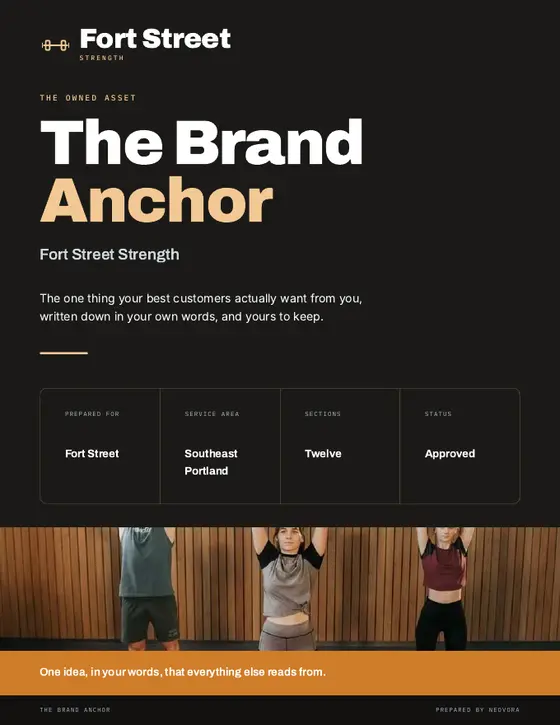
"A membership nobody notices is a membership you quit. Classes cap at twelve with the same coach every week, so when you miss one, somebody texts you by name."
Music school
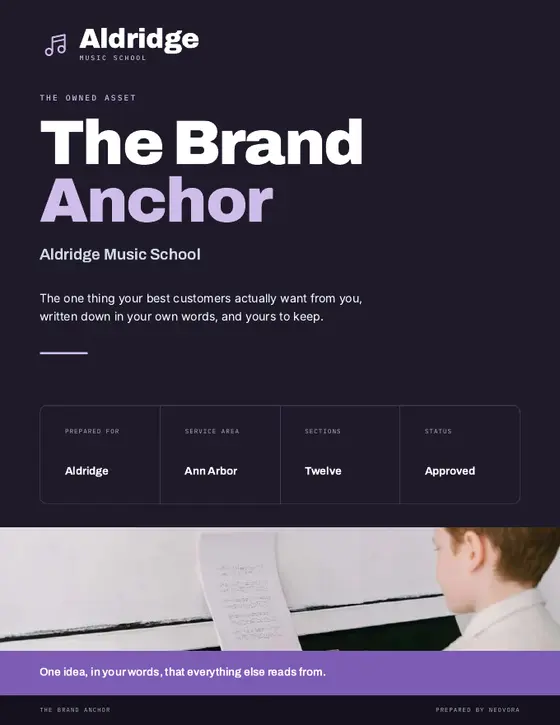
"Kids quit when the first month is scales. We put a real song in his hands inside four weeks, so he's still playing by the spring recital and his grandparents recognize it."
Preschool
"Waitlists are how most parents lose September. We enroll in January with a signed spot and a start date, so going back to work is already on the calendar."
What we actually do
The order is the whole difference.
We read before we write.
Your customers' own words, and every competitor's promise within reach of them, before anybody writes a sentence.
We try to break it.
Each candidate goes through ten tests, then two people who had nothing to do with finding it read the winner cold.
What lands is twelve parts: the one thing your market remembers and why it is true, who it is for, where the words go, ten phrases your people can use on the phone, and what nobody speaking for the business should ever say. Your office writes none of it.
What it sounds like once it's working
Clients started coming in already familiar with how we talk about our work. Not just what we do, but how we explain it. That wasn't happening before.
Before this, I was posting all the time, but it felt random. What surprised me was how quickly that changed. Suddenly clients were repeating things back to me, phrases they'd seen online, stuff from posts, even from captions.
Even after the initial phase, I kept going back to the strategy document. We've used parts of it in emails, sales conversations, even staff training. It didn't just sit there.
And this is just one of three pieces of the Cornerstone
This first piece showcases the reason somebody picks you. But it's the second that gives you transparency into what you paid to get that new customer, and how quickly you can go get the next one.
Start with 15 minutes
First we check whether your area is still open, because we only build this for one business per zone. Then a few questions about how your business runs.
On the same call we work the math through on one example, and then answer your questions. If it's worth going further, we schedule a time to go through last month's figures with you and show you what they reveal.