
The Net Promoter Score comes down to one question: how likely are you to recommend us to a friend or colleague? Customers answer from 0 to 10, and NPS turns all those answers into one number that tells you how your customers feel about you.
What a Net Promoter Score is
The company that helped create the score describes it this way on its own site:
“Net Promoter Score®, or NPS®, measures customer experience and predicts business growth. This proven metric transformed the business world and now provides the core measurement for customer experience management programs the world round.”
The math is simple. Take the share of customers who answer 9 or 10, and subtract the share who answer 6 or lower. Say 100 customers answer. 60 give you a 9 or 10, and 10 give you a 6 or lower. 60 minus 10 is 50, so your score is 50.
Why the score matters
Customers who like you stay longer, spend more and tell their friends. But when a job goes wrong, a lot of customers never tell you. They tell other people instead.
And the bigger your business gets, the fewer jobs you see with your own eyes. Your score is how you keep track of what customers think once you’re not standing on every job.
How your score compares to your industry
Every industry has a typical range. In this chart of sectors from 2013, internet service companies sit at the very bottom, and department and specialty stores sit near the top.
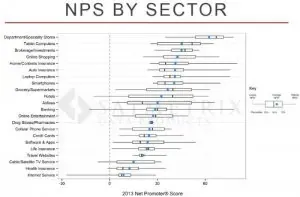
Dentists, hair salons and roofers each have their own range too. So the number that matters is where you sit inside yours, and whether it’s moving up or down.
What the survey tells you
The score sorts your customers into three groups:
- Promoters answer 9 or 10. They like you enough to keep buying and to send friends and family your way.
- Passives answer 7 or 8. They’re happy enough, but they won’t go out of their way to recommend you, and a competitor can pull them away.
- Detractors answer 0 to 6. They aren’t happy, and they may tell other people so.
The survey also asks each group a question or two that they answer in their own words: what they liked, what they didn’t, and what they’d change. And people type things into a survey they’d never say to your face. So you find out exactly what to fix, and exactly what to keep doing.
Why you need a survey tool that sends it for you
A survey only works if it goes out after every job, and not just in the weeks somebody remembers. A survey tool sends it on its own and adds up the score for you.
Reichheld, who created NPS, put the case for the number this way:
“The path to sustainable, profitable growth begins with creating more promoters and fewer detractors and making your net-promoter number transparent throughout your organization. This number is the one number you need to grow. It’s that simple and that profound.”
Asking every customer, every time
The survey has the same problem as asking a happy customer for a review, or hearing an unhappy one out before they post about it. Each one should happen after every job, and in most businesses each one waits on somebody remembering.
The follow-up we build takes the last two off that list. The happy customer gets asked for a review while the job’s still fresh, and the unhappy one reaches you before the internet does. The messages go out on their own, in words your office signed off on once, so nobody has to remember to send them. See everything The Business OS covers.