
Everybody is selling to you. A coach sells advice. A marketing company sells doing the work, by the month. And most owners end up buying the kind of help that happened to call that week, not the kind of help the problem needs.
So before you hire anyone, write down what's actually missing in your business. A lot of it turns out to be neither advice nor work you pay a company to do by the month. Some of it is work your own office could run, and some of it is a number nobody has shown you, like what each new customer really cost.
The 3 questions that sort what your business is missing
Here's one example the whole way through: a home cleaning company with two people in the office. The owner pays a coaching membership $600 a month and a marketing company $1,500 a month, and still has a list of six things that are wrong:
- "I don't know what to charge for the bigger deep-clean jobs."
- "Quotes go out and nobody follows up."
- "Happy customers never leave reviews."
- "I don't know if the ads are paying for themselves."
- "I'm not sure whether to hire a third person or a second crew lead."
- "The marketing company sends a report every month, and I can't tell what my money did."
Instead of handing that list to whoever's selling, ask three questions of every line.
1. Is it a decision you haven't made yet?
If a good answer would settle it, it's an advice gap. Lines 1 and 5 are advice. Once the price is set or the hire is decided, that line is settled.
2. Do you already know what should happen, and it just doesn't happen every time?
That's a doing gap. Lines 2 and 3. Everybody in the office knows the quote should get a follow-up. But on a busy day, nobody has time to remember.
3. Is it about whether the money worked, with no number to tell you?
That's a numbers gap. Lines 4 and 6.
So the list sorts two, two and two. The coach fits lines 1 and 5. The marketing company runs the ads, which doesn't touch lines 2 and 3. And nobody the owner pays is working on lines 4 and 6.
When a business coach is the right help
An advice gap sounds like "I don't know what to charge" or "Should I hire, or add a crew lead?" Plenty of owners take those questions to their marketing company. The problem is, a marketing company is paid to do work every month, so its answer tends to be more work. Ask a company that runs ads what to charge, and the conversation usually ends up back at the ads.
The help that fits is someone whose job is the advice: a coach, a peer group, an accountant, or another owner a few years ahead of you. That's the honest case for a coach. They've usually seen the decision many times, and you're making it for the first time.
Your next step for advice gaps: write the question down before the session, and the decision you made after it. If you can't write down a decision, you got encouragement, not advice. Before you sign up with a coach, ask: "What will we decide together, what will my team have to do afterward, and how will we know whether to keep doing it?"
One limit, though. If the same question comes up every month, it isn't advice anymore. A question you ask every month is usually a process nobody has written down... and that's a doing gap.
When the work belongs in your own office
A doing gap sounds like "We know we should, we just don't." Quotes go out and nobody follows up. Jobs finish and nobody asks for the review. It all depends on somebody remembering.
Some owners hire a coach for this, and the coach says to follow up on every quote. True, and it doesn't change who has time on Tuesday. Others rent it from a marketing company by the month. That can work, but it works for as long as you keep paying, and the steps live in the company's account, not in your office.
So split doing gaps into two kinds.
The first kind repeats the same way every week: the quote follow-up, the review request, the text back to a missed call. Your office approves the words of each message once, and after that the messages go out on their own. Nobody has to remember to send them, and nobody has to write each one. That kind of work belongs in your own office, on your own accounts. (We wrote about the four places inquiries slip away if you want to see where most of it hides.)
The second kind takes specialist skill and changes month to month, like running paid ads. Some owners are right to rent that. An owner who keeps second-guessing every swing in the ad numbers can do better handing the ads to someone who doesn't.

Your next step for doing gaps: before you call any setup finished, run one test. The person in your office who'll own it sends a test quote through while whoever set it up watches. They mark the quote accepted and check that the reminders stop. Then they show a backup person how to do it. If they can do all of that, the work lives in your business. The daily work your own office can run is where lines 2 and 3 from the example list, the quote follow-up and the review requests, get handled.
If nobody in your office can own the work, even an hour a week, keep it rented for now. A system nobody owns stops the same way rented work stops.
How to tell if your marketing is paying for itself
A numbers gap sounds like "I can't tell what my money did." Most owners ask the marketing company for a better report. But clicks and cost per lead don't answer a question about money. Someone who runs marketing for a large home service business, answering a plumber's question, put it plainly:
"Cost per lead and cost per click mean nothing at your size."
A coach usually doesn't have your numbers either. The help that fits is one calculation from your own records, every month. Here it is on the example cleaning company.

- What the ads cost. Last month the ad spend was $1,500 and the marketing company's fee was $1,500. The fee counts, because the business paid it to get those customers. That's $3,000.
- What each customer cost. The records tie 20 new customers to the ads. $3,000 divided by 20 is $150 a customer.
- What's left after the work. Those 20 customers paid $5,000 for their cleans in the first month. Labor and supplies cost $1,800. $5,000 minus $1,800 leaves $3,200. Take off the $3,000 the ads cost, and $200 is left.
That $200 isn't take-home profit, since rent, insurance and the office still come out of it. But now the owner has a real question to answer: is $200 enough for a month of ads? A report that says "$5,000 in sales" would never have shown them that.
Say the company actually got 26 new customers that month, and only 20 can be tied to the ads. Keep the other six marked unknown. Giving every unexplained customer to the ads makes the report look better and the decision worse.
Your next step for numbers gaps: before you renew, ask the marketing company, "Can you show me this math from my own records?" If you only get a handful of new customers a month, one odd job swings the number, so look at two or three months together before you change anything.
What stays when the payment stops
Before you buy any help, ask the question owners already ask themselves: what happens to this the day I stop paying?
- Advice stays. The pricing decision is still made after you cancel the coach.
- Rented work stops with the last invoice, unless the steps are written down and running in your own office.
- Numbers stay only if they're worked out from your own records. A report in someone else's dashboard leaves with them.
Now the example company's bills over 24 months. The coaching membership is $600 times 24, which is $14,400. The marketing company is $1,500 times 24, which is $36,000. Together that's $50,400. If both stop, the pricing and hiring decisions stay, because those were advice. The ads stop. The quote follow-up and review requests were never running, so there's nothing to keep. And nobody was working out the ad math, so nothing stays there either.
That doesn't mean either bill was wasted. It means the owner can now see which part of each bill bought something that stays. So rent help for a new decision, or for a specialist skill that changes month to month. Anything that happens every week is worth setting up once, in your own office, so you keep it.
Sort your own list this week
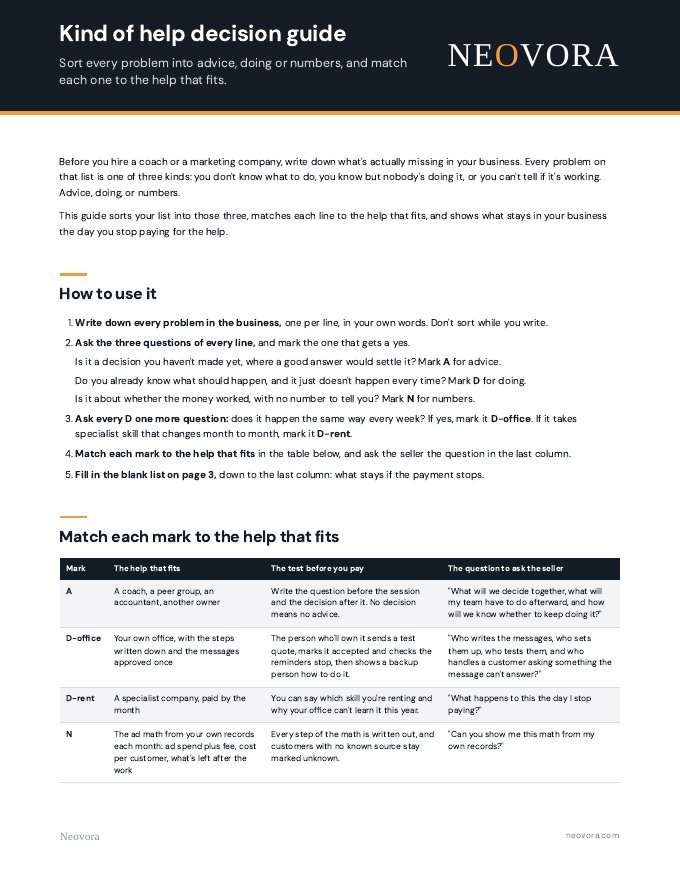
Write every problem in your business on its own line. Then put an A, a D or an N next to each one, and for every D, mark whether it happens the same way every week or takes a specialist. That one page tells you who to pay, who to stop paying, and what to move into your own office.
Free download
Kind of help decision guide
The guide walks you through the sort, with the example company filled in and a blank copy for your own list. Tell us where to send it, and we'll email it to you.
After the guide, we'll send four short emails over the next four weeks, each with one more thing you can use. You keep the guide either way.
For help moving the weekly work of a service business into your own office, anywhere in the US, visit https://www.neovora.com/